
Blog
Sugarcane Bagasse Plates Wholesale: B2B Sourcing Guide

Sugarcane Bagasse Plates Wholesale: The B2B Buyer’s Complete Sourcing & Compliance Guide
If you’re evaluating sugarcane bagasse plates wholesale, you’re likely balancing three competing demands: consistent supply at scale, credible sustainability claims, and unit economics that still work after freight, warehousing, and fulfillment. The good news is that bagasse plates—made from the fibrous residue left after sugarcane juice extraction—have matured into a reliable, high-volume category for foodservice, retail, and institutional buyers. The less-good news is that not all bagasse “looks the same” once you factor in strength, grease resistance, certifications, packaging formats, and real-world performance in hot, wet, or oily foods.
This guide is written for procurement managers, distributors, brand owners, and operators who need a practical playbook—from specs to audits—to source the right product at the right price, without compliance surprises.
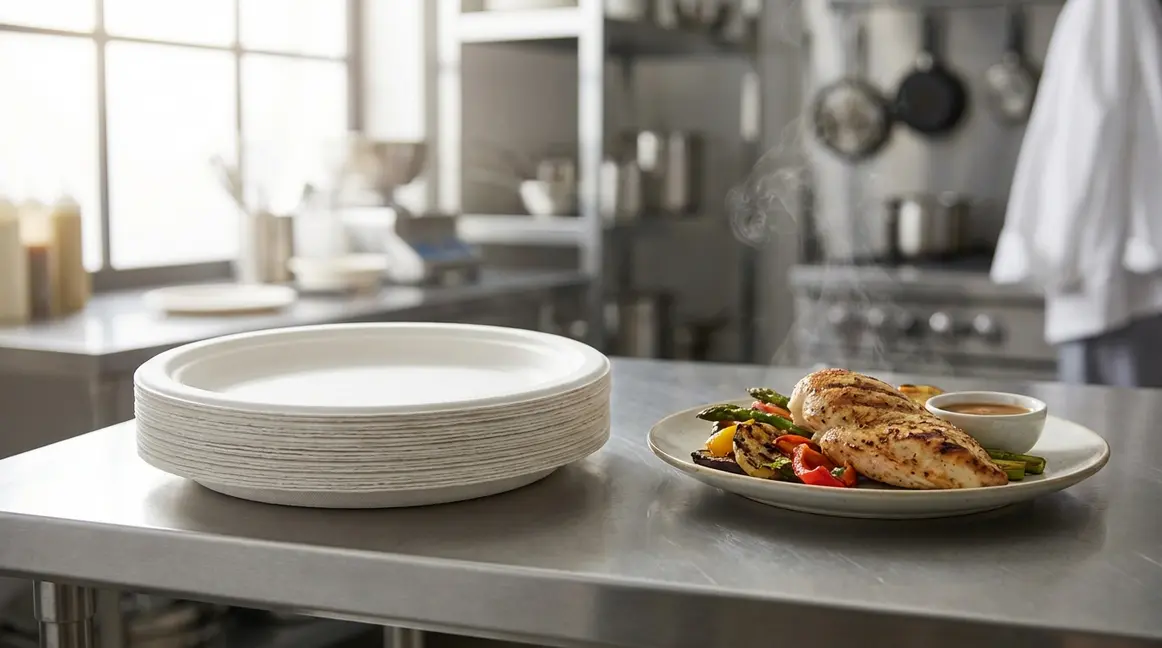
sugarcane bagasse plates wholesale stacked on a catering prep table in a commercial kitchen
What Are Sugarcane Bagasse Plates (and Why Wholesale Buyers Prefer Them)
Sugarcane bagasse plates are molded-fiber disposable plates produced from bagasse pulp. Bagasse is a byproduct of sugar manufacturing. After juice extraction, the remaining fibers are cleaned, pulped, and thermoformed into plates, bowls, clamshells, and trays.
Wholesale buyers typically prefer bagasse over paper or foam for three reasons:
- Performance: Molded fiber plates are rigid, heat tolerant, and handle oily foods better than many paper alternatives.
- Brand positioning: “Plant-fiber” and “made from sugarcane” is an easy sustainability story for foodservice and retail shelves.
- Regulatory tailwinds: Many regions restrict expanded polystyrene (EPS) foam and increasingly scrutinize plastic-coated papers.
Key Wholesale Use Cases (Who Buys in Volume and Why)
Demand for sugarcane bagasse plates wholesale tends to cluster in sectors where disposables are operationally necessary, but customer expectations are rising.
Foodservice & QSR Chains
- High throughput, predictable SKU mix (6–10 inch plates, 3-compartment plates, platters).
- Need consistency in rigidity, stackability, and heat resistance.
- Often require stable long-term pricing and vendor-managed inventory options.
Catering, Events, and Venues
- Demand peaks seasonally; must handle saucy, oily, and hot foods.
- Plate aesthetics matter (smooth finish, bright white or natural).
- Packaging should be easy to open and distribute at scale.
Distributors & Cash-and-Carry
- Need pallet-friendly cases, strong master cartons, and clean barcode labeling.
- Prefer a tight assortment that turns quickly across customer segments.
Retail & Private Label Brands
- Require consumer-facing packaging, compliance markings, and brand-ready design.
- Care about shelf life, odor control, and packaging integrity.
Institutions (Schools, Corporate Dining, Healthcare)
- Higher scrutiny on food-contact safety and chemical compliance.
- Often require documentation packages and traceability.
Bagasse vs. Cornstarch Tableware: How to Choose for Your Product Line
Buyers comparing sugarcane bagasse and cornstarch often conflate “eco-friendly.” They’re different material families with different strengths.
Sugarcane Bagasse (Molded Fiber)
- Best for: Plates, bowls, trays, clamshells for hot/greasy foods.
- Strength & rigidity: Typically excellent, especially in 9–10 inch plates and compartment trays.
- Heat performance: Commonly microwave-safe (verify by model), good for hot holding.
- Look & feel: Natural fiber texture; can be brighter white with processing, or off-white/natural.
Cornstarch (Usually Bioplastic Blends)
- Best for: Cutlery and some cold-food applications depending on formulation.
- Strength: Can be strong, but heat limits vary widely; some items deform under high heat.
- Finish: Smoother plastic-like appearance.
If your core business is hot meals, saucy foods, and catering, sugarcane bagasse plates wholesale typically deliver the best performance-to-cost ratio. Cornstarch can complement the range—especially for cutlery—but should be evaluated SKU-by-SKU with heat and load tests.
Wholesale Specifications That Actually Affect Performance (Not Just Marketing)
Two bagasse plates can look identical in a catalog and behave very differently in service. Here are the specs to request and verify.
1) Grammage / Basis Weight and Mold Density
Heavier plates generally feel sturdier, but process and mold design matter too. Ask for:
- Target weight per piece (e.g., grams/plate)
- Thickness ranges
- Compression/rigidity test data if available
2) Grease & Water Resistance (and What Coatings Are Used)
Many bagasse plates are naturally grease resistant, but performance varies with pulp quality and additives. Key questions:
- Is any surface treatment used?
- Is it PFAS-free (no fluorinated grease-proofing)?
- Does the plate maintain rigidity after 30–60 minutes with hot/oily food?
For B2B buyers, “PFAS-free” is not a buzzword—it’s a risk-control measure. Require a signed declaration and, for higher-risk channels, third-party test reports.
3) Heat Tolerance and Microwave Performance
“Microwave-safe” is often used loosely. Confirm:
- Temperature limits (hot food, heat lamps, warming cabinets)
- Microwave test method and duration
- Warping thresholds and acceptable deformation
4) Compartments, Rim Geometry, and Stackability
Rim design influences stiffness and user experience. For compartment plates, the depth and wall angle affect sauce migration and lid fit (if paired with clamshells).
5) Odor, Color Consistency, and Surface Finish
- Odor: Poor washing or storage can create a “wet fiber” smell.
- Color: Natural/off-white vs bright white; ensure the look aligns with your brand.
- Finish: Smoothness impacts perceived quality in retail and premium catering.
Certifications and Compliance: What B2B Procurement Should Require
Compliance is where many wholesale programs succeed or fail. Your documentation package should match your sales channels and geography.
Food-Contact Safety
- EU: Framework Regulation (EC) No 1935/2004 and relevant GMP requirements (EC 2023/2006). Many molded-fiber products are supported with migration testing aligned to intended use.
- US: FDA food-contact expectations are often supported through material declarations and supplier attestations; some buyers also request third-party testing (overall migration, heavy metals, etc.).
Request a Declaration of Compliance (DoC) or equivalent letter, plus lab reports as needed for your category and region.
Compostability (Industrial vs. Home)
Compostability claims should be precise. In most markets, bagasse plates are positioned for industrial composting. Common references include:
- EN 13432 (EU compostability standard)
- ASTM D6400 / D6868 (US compostability standards; often applied to compostable plastics and coated products)
- Third-party marks where applicable (verify scope and SKU coverage)
Avoid vague claims like “100% compostable everywhere.” For B2B contracts, insist that certifications cover the exact SKU, not a “similar product family.”
PFAS-Free and Restricted Substances
Many corporate buyers and municipalities now require PFAS-free disposable foodware. Ask for:
- PFAS-free declaration
- Testing to relevant methods (where required)
- Restricted substances policy (heavy metals, optical brighteners, etc.)
Forest and Fiber Claims
Bagasse is agricultural residue, not wood pulp. If your customer base requests “tree-free,” ensure you can substantiate it and that any blended fibers (if used) are disclosed. Transparency reduces reputational risk.
Wholesale Packaging Formats and Case Pack Economics
When sourcing sugarcane bagasse plates wholesale, packaging is not an afterthought—it drives labor cost, damage rates, and warehouse efficiency.
Common Pack Styles
- Bulk foodservice cases: Plates in sleeves inside a master carton (best for distributors and operators).
- Retail packs: Smaller count packs with printed film or boxes, barcode-ready.
- Club store: High count, reinforced packaging, strong shelf presence.
What to Standardize in Your RFQ
- Pieces per sleeve, sleeves per case, pieces per case
- Case dimensions and gross weight (for palletization and freight)
- Carton strength (ECT/BCT targets), corner protection
- Pallet pattern, pallet height, stretch-wrap spec
- Labeling: SKU, lot code, country of origin, compliance icons, barcode
Small changes in case pack can materially change your landed cost. A “cheaper” plate can become more expensive if it increases breakage, cube, or pick/pack time.
How to Evaluate a Wholesale Supplier: A Practical Scorecard
There are many factories and trading companies in this space. The right partner is the one that can deliver repeatable quality with strong documentation, not just the lowest quote.
1) Manufacturing Capability and Capacity
- Number of production lines and monthly output by SKU category
- Mold management process (mold wear affects dimensions and nesting)
- In-house QC checkpoints (incoming fiber, forming, drying, packing)
2) Quality Control and Traceability
- Lot coding that ties finished goods to production date and raw material batches
- Sampling plan (AQL) and retention samples
- Defect definitions: warping, black specks, delamination, uneven edges
3) Documentation Readiness
- DoC / food-contact statements
- Compostability certificates (if claimed)
- PFAS-free documentation and test reports (if required)
- Factory audits (e.g., social compliance, quality systems) if your customers require them
4) Communication and Pre-Shipment Discipline
- Pre-production samples with signed golden sample approval
- Pre-shipment inspection option with clear pass/fail criteria
- Issue resolution process (CAPA) and credit/claim policy
Private Label and Customization Options (What’s Realistic at Wholesale Scale)
Many buyers come to sugarcane bagasse plates wholesale planning a private-label launch. Customization is viable, but you should align expectations with tooling and MOQs.
Common Custom Options
- Retail packaging: Custom printed sleeves/film, cartons, and inserts.
- Embossed logo: Sometimes possible on plate rim (depends on mold design).
- Color tone: Natural vs brighter white (subject to material and process).
MOQs and Lead Times (Typical Considerations)
- Stock SKUs: faster, lower MOQ, ideal for demand validation.
- Custom packaging: moderate MOQ; printing proofs and approvals required.
- New molds: higher upfront tooling cost; longer development timeline; best for long-term programs.
For most B2B brands, the most cost-effective route is: start with a standard plate SKU, differentiate through packaging and documentation, then invest in unique molds once volumes justify it.
Landed Cost Breakdown: How to Compare Wholesale Quotes Correctly
Wholesale sourcing decisions go wrong when buyers compare only EXW or FOB unit prices. For sugarcane bagasse plates wholesale, landed cost is shaped by freight, cube, packaging, and damage rates.
Key Cost Components
- Unit price: Plate cost based on weight, finish, and specs.
- Packaging: Inner sleeves, master cartons, retail printing, palletization.
- Freight: Ocean/rail/truck; volumetric weight matters because plates are bulky.
- Duties/tariffs: Vary by destination and origin.
- Inspection and compliance testing: Particularly for regulated channels.
- Warehousing: Pallet positions and handling.
- Quality loss: Breakage, warping, contamination, mislabeling.
A Simple Comparison Method
- Convert each quote to cost per 1,000 plates delivered to your warehouse.
- Adjust for case cube (how many cases fit per container or truckload).
- Add a conservative allowance for defects based on supplier track record.
This method often reveals that a slightly higher unit price can win once you account for fewer pallets, fewer claims, and smoother fulfillment.
Quality Testing: What to Test Before You Commit to a Container
Before scaling a wholesale program, run simple, repeatable tests that mimic real use. A strong supplier will welcome this because it prevents disputes later.
Operational Performance Tests
- Hot oil test: Add hot oily food; check soak-through and rim softening after 30/60 minutes.
- Load test: Standard weight (e.g., 1–2 kg) held for a set time; assess bending.
- Cut resistance: Knife and fork use on the surface (important for retail and catering).
- Microwave test: Defined time and power; check warping and odor.
- Nesting/dispensing: Confirm stack separates cleanly without sticking.
Incoming QC Checks for Every Shipment
- Visual defects (black specks, uneven edges, dents)
- Dimensions and plate depth (tolerance checks)
- Count verification per sleeve/case
- Carton integrity after transit
Storage, Shelf Life, and Handling: Protecting Your Inventory
Bagasse products are hygroscopic (they can absorb moisture). To reduce warping and odor issues:
- Store in a dry, ventilated warehouse away from strong odors and chemicals.
- Avoid high humidity and direct contact with floor—use pallets and proper stretch wrap.
- First-in, first-out (FIFO) to prevent aged stock and packaging degradation.
- Keep cartons sealed until use to reduce moisture uptake.
Ask your supplier for recommended storage conditions and shelf-life guidance based on packaging type.
Sustainability Claims That Hold Up in B2B Sales (and What to Avoid)
Sustainability sells, but B2B buyers increasingly face scrutiny from enterprise customers, municipalities, and auditors. If you sell or distribute sugarcane bagasse plates wholesale, align your claims with verifiable facts.
Claims That Are Typically Defensible (When Documented)
- Made from sugarcane bagasse (agricultural residue) with clear material disclosure.
- Plastic-free (if no plastic coating is used).
- PFAS-free (with declaration/testing aligned to requirements).
- Industrial compostable (only if certified for the specific SKU/structure).
Claims to Be Careful With
- “Home compostable” unless you have region-appropriate certification and the product reliably breaks down in home conditions.
- “Biodegradable” without context—many jurisdictions consider it misleading without standardized proof.
- “Zero waste” unless you can support end-of-life collection and processing.
When in doubt, sell the operational benefits and compliance strength—not just the sustainability story.
Procurement Checklist: Your RFQ Template for Sugarcane Bagasse Plates
Use this checklist to standardize supplier quotes and speed up decision-making.
- Product specs: size (inch/mm), shape, compartments, weight per piece, color, finish
- Performance requirements: microwave/heat limits, grease resistance, rigidity expectations
- Compliance: food-contact DoC, migration tests, PFAS-free declaration, compostability certificates (if claimed)
- Packing: pieces/sleeve, sleeves/case, carton dimensions, pallet pattern
- Branding: stock vs custom packaging, artwork requirements, barcodes
- Commercial terms: MOQ, lead time, Incoterms (EXW/FOB/CIF/DDP), payment terms
- Quality: AQL, defect definitions, claim window, replacement/credit policy
- Logistics: port of loading, container optimization, shipment photos, pre-shipment inspection
Common Mistakes Buyers Make in Wholesale Bagasse Sourcing
- Approving based on one sample only: Request pre-production and production-run samples to check consistency.
- Ignoring carton strength: Weak cartons lead to crushed inventory and returns.
- Assuming “compostable” equals compliant everywhere: Claims must match local rules and certifications.
- Not specifying PFAS-free: If your end customers require it, make it contractual upfront.
- Comparing prices without cube: Freight cost per plate can swing significantly based on case dimensions.
Frequently Asked Questions
1) What is the typical MOQ for sugarcane bagasse plates wholesale?
MOQ varies by supplier and whether you’re buying stock or custom. Stock items may start at a few hundred to a few thousand pieces, while container-load programs and custom retail packaging typically require higher MOQs. The most accurate approach is to request MOQs by SKU and pack style (bulk vs retail).
2) Are sugarcane bagasse plates microwave-safe?
Many bagasse plates are suitable for microwave reheating, but performance depends on plate design, thickness, and any additives or surface treatments. Confirm the supplier’s test conditions (time, power, food type) and run your own validation with your menu items before rolling out.
3) How can I verify PFAS-free claims for bagasse plates?
Ask for a signed PFAS-free declaration and, if your channel requires it, third-party test reports using methods accepted in your market. Include PFAS-free language in purchase contracts and define what happens if a shipment fails compliance testing.
4) What should I prioritize when choosing a supplier for sugarcane bagasse plates wholesale?
Prioritize repeatable quality, documentation readiness, and packaging/labeling consistency—then price. A supplier that can support traceability, pre-shipment inspections, and clear defect standards typically reduces your total cost of ownership over time.
Whether you’re building a private-label program, supplying foodservice accounts, or upgrading away from foam and plastic-coated paper, sourcing sugarcane bagasse plates wholesale is easiest when you treat it like any other strategic category: lock your specs, demand clear compliance documentation, and compare suppliers on landed cost—not just unit price. Done right, sugarcane bagasse plates wholesale becomes a dependable, scalable product line that satisfies operational needs and modern sustainability expectations.
Welcome to contact us to get price now!